Why is everything grey? The real reason we're losing colour
By Cameron Karri · Updated · 11 min read
The short answer.
Colour has not got more expensive to make. It has got more expensive to risk. Many big purchases, from cars to homes, are now chosen with the next buyer, a finance company or an algorithm in mind, and neutrals are the safest bet for all three. Grey sells faster, but it does not hold its value better.
Jump to
- Is the world really losing colour?
- Why are all cars grey now?
- Do grey cars hold their value better?
- Why does colour cost extra on a new car?
- Why do all websites and brands look the same?
- Why are homes painted grey and beige?
- So what is the real reason everything is grey?
- Is colour coming back?
- What does this mean for your brand?
- How we researched this
- Sources
Is the world really losing colour?
In the things we make and buy, yes, and it can be measured. When the Science Museum Group analysed photographs of 7,083 everyday objects, the most common colour was a dark charcoal grey. It appeared in over 80% of the photographs (Science Museum Group).
Across the collection, the researcher, Dr Cath Sleeman of Nesta, found "a substantial rise in the use of grey" over time, with a fall in brown and yellow (PEC). She links it to materials: the move away from wood and towards plastic. Phones show the pattern clearly. They came in a wide range of colours from the 1960s, then began "greying" in the late 1980s with the brick phone (Science Museum Group).
The study is a museum data project rather than a peer-reviewed paper, and the collection is not a random sample. Its own author calls the results preliminary. It is still the largest direct measurement of everyday objects we found.
The greying is not everywhere, though. An analysis of 120,013 paintings found art got brighter and bluer over the centuries, not darker (Significance). A University of Waterloo study of more than 29,000 film trailers from 1960 to 2019 found modern technology has let filmmakers use a wider variety of colour (TechXplore).
So the more precise statement is this: colour is draining out of the things we buy and own, not out of culture. That distinction points straight at the real cause.
Even the colour industry has noticed. Pantone's Colour of the Year for 2026 is Cloud Dancer, which it calls "a lofty white" (Pantone). It is the first white in the programme's history, which began in 1999 (Smithsonian Magazine).
Why are all cars grey now?
Grey has been the UK's most popular new car colour for eight years running. In 2025, 558,050 new cars were grey, 27.6% of the market (SMMT). Red slipped to 5.8%, its lowest share since detailed records began.
To see the longer trend, we went through SMMT's annual colour releases from 2014 to 2025 and put the published figures side by side.
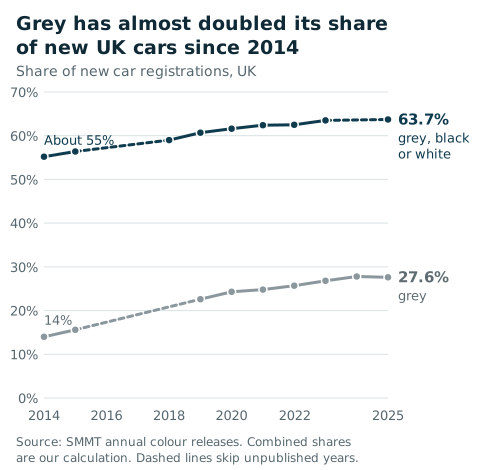
| Year | Top colour | Grey share | Grey, black or white |
|---|---|---|---|
| 2014 | White | 14% | About 55% |
| 2015 | White | 15.6% | 56.4% |
| 2018 | Grey | Not published | 59% |
| 2019 | Grey | 22.6% | 60.7% |
| 2020 | Grey | 24.3% | 61.6% |
| 2021 | Grey | 24.8% | 62.4% |
| 2022 | Grey | 25.7% | 62.5% |
| 2023 | Grey | 26.8% | 63.5% |
| 2024 | Grey | 27.8% | Not published |
| 2025 | Grey | 27.6% | 63.7% |
Figures from SMMT releases for each year. The 2014, 2015 and 2025 combined shares are our calculation from SMMT's published numbers. SMMT rounded the 2014 shares, so that year is approximate.
Two things stand out. Grey's share almost doubled in 11 years. And the combined share of grey, black and white rose in every year shown in the table.
The most revealing pattern is in the top spot itself. Silver led UK sales from 2000 to 2008, black from 2009 to 2012, white from 2013 to 2016, black again in 2017 and grey from 2018 (SMMT, SMMT, SMMT, SMMT). White went from less than 1% of new cars in 2005 to the top spot within eight years (SMMT).
Fashion has not stopped. It now moves between neutrals instead of between colours. Before 2000 it was different: an analysis of cars still on the road found red was Britain's favourite car colour from 1973 to 1997, and blue led new car sales in 1998 (Fleet News, SMMT).
The same pattern holds worldwide. BASF's 2025 report puts white at 33%, black at 23%, grey at 19% and silver at 8% of new cars globally, 83% between them, with red at just 3% (BASF). Axalta's 2025 report, which measures differently, has white at 29%, black at 23% and grey at 22% (Axalta).
Do grey cars hold their value better?
Not really. In the largest study, grey lost about the average amount of value and yellow lost the least. Neutral cars sell faster, but they do not reliably hold their value better.
| Colour | Value lost after three years (US) | Average days to sell (UK) |
|---|---|---|
| Yellow | 24.0% | 41.5 |
| Green | 26.3% | 36.2 |
| Grey | 30.5% | 34.2 |
| Black | 31.9% | 36.0 |
| White | 32.1% | 35.0 |
Value lost: iSeeCars study of more than 1.2 million used cars, model year 2022, average 31.0% (iSeeCars). Days to sell: 2019 UK study by Crusader Vans (Motoring Research). The two studies are separate and measure different markets.
Yellow cars lost the least value, and grey cars sold fastest. iSeeCars' explanation is supply and demand: bright colours are rare, so demand outstrips supply on the used market. Common colours are easy to compare, so buyers can always find a cheaper one.
The UK study found the same split. Yellow lost 27% over three years, the least of any colour, but took 41.5 days to sell against 34.2 for grey (Motoring Research).
Trade buyers still prefer neutrals, probably because they are predictable. cap hpi, which analysed 1.5 million trade sales, found white achieved the highest trade values, with green around 16% lower (Fleet News).
So neutral colours do not win on value. They win on speed and certainty. That is the clue.
Why does colour cost extra on a new car?
On many new cars, colour is now an upgrade you pay for. A neutral is often the only free choice.
| Car (UK) | Free colour | Price of colour |
|---|---|---|
| Tesla Model 3 | Stealth Grey (and black on the base model) | Pearl White £1,300, red £2,000 |
| Volkswagen Golf | One white, two greys, black and two blues | Kings Red £990 |
| MG4 | Arctic White | Metallics £545, Dynamic Red £695 |
| Kia Sportage | Standard paint | Premium paint £675 |
Tesla free colours from Motoring Research and prices from Electrifying.com, April 2025. Golf and MG4 prices via carwow (Golf, MG4). Kia from Kia UK. Prices change often, so check before you buy.
This is not new. In 2017, Parkers found 30 of the UK's 50 best-selling cars offered only one paint finish within the list price, and metallic paint added £536 on average (CAR magazine).
The paint itself is not the expensive part. Synthetic dyes have made colour cheap since William Perkin discovered mauveine in 1856; before that, dyes came from plants and insects and were "expensive to make" (Science Museum).
The cost today is complexity. Every extra colour means more stock, more changeovers and more to manage. In 2018 Elon Musk moved "2 of 7 Tesla colors off menu" to "simplify manufacturing" (AutoGuide). In 2024 GM cut paint options across its brands under a programme called "Winning with Simplicity" (GM Authority). Mattel cut its roughly 150 shades of red by more than a third. As one Mattel executive put it, "Complexity is really a killer" (Supply Chain Digest).
Why do all websites and brands look the same?
Websites look the same because they are built from the same parts. The best evidence is a 2021 study from Indiana University that measured 227,802 screenshots of 10,482 websites from 2003 to 2019 (Goree et al., CHI 2021).
The researchers found designs "have become significantly more similar since 2007, especially for page layouts", where the average distance between sites fell by over 30%. On large corporate websites, colour difference fell by 32% and layout difference by 44%.
They traced it to three causes: shared code libraries, colour scheme standardisation and support for mobile devices. Use of the popular Bootstrap framework "correlates strongly" with sites having more similar layouts. Drawing on interviews with 11 experienced designers, the researchers concluded that designers are "under more pressure to comply with branding guidelines and avoid unusual color combinations."
One detail matters for honesty. Colour only became more similar on the corporate sites. On popular and award-nominated sites, colour stayed varied. Big organisations, with the most to lose, are the ones playing it safest.
Brand identities show the same instinct. Fashion houses including Balenciaga, Burberry, Saint Laurent and Celine moved to strikingly similar plain wordmarks (The Drum). The design industry calls it "blanding" (Adweek). Burberry reversed its own version in 2023, bringing back an equestrian knight emblem from around 1901 (Design Week).
Platforms add their own pressure. The writer Kyle Chayka calls it "Filterworld": recommendation algorithms promote "the least ambiguous, least disruptive, and perhaps least meaningful pieces of culture" (NPR via VPM). In an earlier essay he quoted a strategist who said "every coffee place looks the same", with the same raw wood, exposed brick and Edison bulbs worldwide (Kyle Chayka).
AI tools may push further in the same direction. A 2024 study in Science Advances found stories written with AI help were more similar to each other than stories written by people alone (Doshi and Hauser). For web design specifically, the evidence is still early.
Why are homes painted grey and beige?
Homes are painted neutral because we decorate them for the next buyer. Rightmove's advice to sellers is direct: "If redecorating, keep the colours neutral and allow buyers to decide how they add their own stamp" (Rightmove). Purplebricks warns that "bold colour schemes can turn buyers off" (Purplebricks).
The evidence is more nuanced than the advice. In a 2025 Zillow survey of more than 4,200 US buyers, a dark grey living room raised what buyers said they would pay by $2,593, while a yellow kitchen lowered it by $3,915 (Zillow). Navy and olive green also added value. Buyers penalise loud colours, not colour itself.
People are not happy with the result either. In a 2025 UK poll of 2,000 adults for wallpaper brand Lust Home, 46% said they were "bored of white, grey, and beige", yet 63% were nervous about introducing brighter colours (The Scotsman). The appetite for colour is there. The nerve is not.
So what is the real reason everything is grey?
The real reason is that colour has turned from a personal choice into a financial risk. Three forces make it so, and they reinforce each other.
1. We choose for the next owner, not ourselves. Most new cars are now bought for someone else's balance sheet. Fleets took a record 59.6% of new UK registrations in 2024 (SMMT). Finance from members of the Finance and Leasing Association, arranged at the point of sale, covered over 85% of private new car registrations in 2025 (FLA). On a PCP deal, the car's future value is set when you sign (Bank of England), so the funder has a stake in the colour you pick. As a lease broker puts it, you pay for "the difference in what the funder thinks it's worth" (Carparison). Homes work the same way, decorated for a buyer we have never met.
2. Makers save money by offering less. Every colour adds cost and complexity, so the default becomes neutral and colour becomes a paid extra. That nudges millions of buyers towards grey before they have chosen anything.
3. Shared tools and platforms reward the middle. Websites share frameworks and templates, brands follow the same guidelines, and algorithms promote what offends nobody. Each choice is sensible on its own. Together they produce sameness.
Behind all three is a well-studied piece of psychology. A classic 1992 study in the Journal of Consumer Research found "choices of conventional or default options are associated with lower regret and responsibility" (Simonson). Grey is the conventional option. Nobody gets blamed for choosing it.
It is not that people dislike colour. When YouGov asked people in ten countries, blue was the favourite everywhere, chosen by 33% of people in Great Britain (YouGov). Research also shows personal colour preference is "secondary" to practical factors when people actually buy (Yu et al.).
Put it together and the picture is clear. Neutral colours do not make things worth more. They make things easier to sell, finance, manufacture and approve. We are designing for the exit.
Is colour coming back?
There are early signs, but they are still small. Green car registrations rose 46.3% in 2025 to 99,793, the most since 2004, a rise SMMT links to electric cars (SMMT). Blue took third place in 2024 for the first time since 2010, and held it in 2025 (SMMT).
The trend forecasters are leaning the same way. Dulux chose a family of blues called Rhythm of Blues for 2026 (Dezeen). WGSN and Coloro picked Transformative Teal for 2026 (MR Magazine) and Luminous Blue for 2027 (WGSN). In 2021, Apple relaunched the iMac in seven colours (Apple).
Still, grey, black and white made up almost two thirds of new UK cars in 2025. Colour is returning at the edges, not the centre.
What does this mean for your brand?
When everything looks the same, standing out gets cheaper. Kantar found strong brand cues, such as a recognisable shape, logo or colour, increase brand saliency by 52% (Kantar).
Owning a colour is hard, which is exactly why it is valuable. In an Ipsos and Jones Knowles Ritchie study of 5,046 brand assets across 523 brands, only 4% of colour assets were truly distinctive on their own (Ipsos, Business Wire). The few brands that own a colour have something most competitors do not.
For a small business, that means a few practical steps:
- Choose one colour you can own in your market. Look at your five nearest competitors first. If they are all navy and grey, that is your opening.
- Use it consistently everywhere. Website, signs, vans, social posts and invoices. A colour only becomes yours through repetition.
- Do not accept your template's default palette. Templates and frameworks come with default colours, and shared frameworks are one of the main reasons sites look alike. Our comparison of Next.js and WordPress covers the trade-offs of building on templates.
- Put the brief in writing. If you work with a designer, say which colour is yours and why. Our guide on how to brief a web design agency shows what to include.
Colour still needs to work hard: readable text, good contrast and a site that loads fast. Our small business website checklist covers the basics. If you want a website built around a colour people remember, that is what our website service does.
How we researched this
We compiled the figures above from SMMT's annual colour releases for 2014 to 2025, using only numbers stated in each release's text. Where we combined colours into one share, we say so, and the arithmetic uses SMMT's own registration totals. Every other figure was checked against the original page in October 2026.
Several sources are industry studies or surveys rather than peer-reviewed research, and two of the most useful (iSeeCars and Zillow) cover the US. We have labelled these throughout. Correlation in these studies is not proof of cause.
Sources
- Colour and shape: using computer vision to explore the Science Museum Group collection, Dr Cath Sleeman, Science Museum Group Digital Lab, 2020
- A little greyer and a bit more rectangular?, Dr Cath Sleeman, Creative Industries Policy and Evidence Centre, March 2021
- The colours of paintings: blue is the new orange, Significance magazine
- Scientists put a picture on decades of movies, TechXplore, reporting University of Waterloo research, March 2023
- Pantone Colour of the Year 2026: Cloud Dancer, Pantone
- You read that right: white is Pantone's 2026 Color of the Year, NPR via GPB, December 2025
- Pantone's Color of the Year for 2026 is a blank canvas, Smithsonian Magazine, December 2025
- SMMT annual new car colour releases, 2015 to 2026, including 2025 data, 2023 data, 2022 data, 2021 data, 2020 data, 2019 data, 2018 data, 2017 data, 2015 data and 2014 data
- Grey still Britain's top new car colour but blue bounces up the charts, SMMT, January 2025
- New car colours: are buyers becoming more conservative?, SMMT, September 2005
- UK new car market breaches two million, SMMT, January 2026
- Record EV market share but weak private demand frustrates ambition, SMMT, January 2025
- Most popular car colours since 1900, Fleet News
- BASF Color Report 2025, BASF, January 2026, and the full report
- Axalta 2025 Global Automotive Color Popularity Report, Axalta, December 2025
- Car color study, iSeeCars, 2025
- Yellow cars retain value best, says study, Motoring Research, October 2019
- Values: tastes can change quickly on colour, Andrew Mee, cap hpi, Fleet News
- Tesla swaps free colours in the UK, Motoring Research, April 2025
- Not all white now: Tesla adds colours, Electrifying.com, April 2025
- Volkswagen Golf colours and prices and MG4 colours and prices, carwow
- Kia Sportage pricing, Kia UK
- The great British paint rip-off, CAR magazine, January 2017
- Mauve mania, Science Museum, March 2018
- Tesla trims paint color options for Model 3, AutoGuide, September 2018
- Why is GM slashing its exterior color options?, GM Authority, October 2024
- Mattel tackles supply chain basics, Supply Chain Digest, January 2020
- Investigating the homogenization of web design: a mixed-methods approach, Goree, Doosti, Crandall and Su, CHI 2021
- The continued blanding trend that goes against industry research, Adweek, November 2023
- Fashion shot the serif, The Drum, November 2020
- Burberry new logo, Design Week, February 2023
- In Filterworld, only you can save yourself from bad taste, NPR, January 2024
- AirSpace, redux, Kyle Chayka, 2022, first published by The Verge in 2016
- Generative AI enhances creativity but reduces the diversity of novel content, Doshi and Hauser, Science Advances, 2024
- Preparing your property for sale, Rightmove
- How to sell your house quickly, Purplebricks
- These paint colors can boost your home's sale price, Zillow, June 2025
- Homeowners turn to dopamine decor, The Scotsman, September 2025
- Consumer car finance new business volumes grew by 7% in June 2026, Finance and Leasing Association, August 2026
- Car finance: what's new?, Bank Underground, Bank of England, August 2017
- Can paint colour make your car lease more expensive?, Carparison, October 2025
- The influence of anticipating regret and responsibility on purchase decisions, Itamar Simonson, Journal of Consumer Research, 1992
- Blue is the world's favourite colour, YouGov, May 2015
- The role of individual colour preferences in consumer purchase decisions, Yu et al., Color Research and Application, 2018
- Rhythm of Blues is Dulux Colour of the Year 2026, Dezeen, September 2025
- WGSN and Coloro announce Colour of the Year 2026: Transformative Teal, MR Magazine, September 2024
- WGSN and Coloro reveal Colour of the Year 2027: Luminous Blue, WGSN
- iMac features all-new design in vibrant colours, Apple, April 2021
- What role do brand cues have in brand equity?, Kantar, June 2021
- Be distinctive. Everywhere., Ipsos and Jones Knowles Ritchie, June 2023, and the Business Wire release
Questions people also ask.
- What is the most popular car colour in the UK?
- Grey. It was the UK's most popular new car colour for the eighth year running in 2025, with 558,050 registrations and a 27.6% share, according to SMMT. Black was second and blue third. Red fell to 5.8%, its lowest share since detailed records began.
- What car colour holds its value best?
- Yellow, in the largest recent study. iSeeCars analysed more than 1.2 million used cars in the US and found yellow cars lost 24.0% of their value over three years, against an average of 31.0%. A 2019 UK study also put yellow first. The catch is that yellow cars take longer to sell.
- Why do so many websites look the same?
- Mostly because they are built with the same tools. A 2021 study of 227,802 website screenshots found the average difference in page layouts between sites fell by over 30% since 2007. The researchers linked it to shared code libraries such as Bootstrap, designing for mobile and stricter brand guidelines.
- What is Pantone's Colour of the Year for 2026?
- Cloud Dancer, PANTONE 11-4201, a soft white. Pantone describes it as a lofty white and a symbol of calming influence. NPR and Smithsonian Magazine both report it is the first white in the programme's history, which began in 1999.